Document:
Euston Portal headhouse: Frequently asked questions
Headhouse purpose and location
What is a headhouse and why are they needed?
Headhouses are above-ground buildings that allow exit from the rail tunnel in case of an emergency. They also provide access for emergency services and for maintenance requirements.
The number and locations of our headhouses were agreed with the London Fire Brigade and are required to meet all necessary safety and evacuation regulations. The design of the railway as well as the available space in the existing railway cutting were also key factors.
We are building two headhouses in the Euston Approaches/Camden Cutting: Euston Portal Headhouse and Euston Cavern Headhouse. Euston Portal Headhouse will be located in the railway cutting opposite Silsoe House, south of Mornington Street bridge, approximately 400m south of the Euston Cavern Headhouse, which will be situated close to the top of Park Village East.
Unlike anywhere else on the HS2 route, the downline and upline tunnels sit at different levels and the headhouses ensure there is multiple points of escape and access to street-level from both tracks in emergency situations. In addition, the Portal headhouse provides ventilation to the Euston portal below, as well as powers the future HS2 railway in this section of cutting including Cavern Headhouse.
What exactly will the Portal headhouse comprise of?
Images of the final design are available online here.
The headhouse building will be set back from the road behind Park Village East parapet wall and a new access gate.
Between the wall and the headhouse will be a hardstanding area for emergency and maintenance vehicles.
The portal headhouse building will contain lifts, and mechanical and electrical equipment.
The exterior of the portal headhouse will include an architectural feature noise barrier and a green roof and other vegetation.
The headhouse will not have any office space and will not be staffed when not in use.
The headhouse will be closely monitored by security system. If there is any unauthorised activity, the radar detection systems will automatically alert the security, who can then monitor the CCTV at the control centre.
Where will the Portal headhouse be located?
The Euston Portal headhouse will be located in the railway cutting opposite Silsoe House, south of Mornington Street bridge. It will be built up from track level and sit on top of the concrete box HS2 trains will pass through between Mornington Street bridge and Granby Terrace bridge.
Structure and shape
How big will it be/will we see it?
The headhouse will be set back from the Park Village East parapet wall by approximately 25 metres and has been designed to be as low as possible. The building will be visible, the top being eight metres above Park Village East Street level, though will be hidden from some angles by the vegetation in the reinstated planter. The headhouse is approximately 65 metres from Mornington Terrace.
The height is required to ensure there is space for all the necessary equipment.
The upper part of the building also includes a noise screen to reduce the amount of noise once the headhouse is operational. This is primarily generated by the transformers located within the building, which are used to operate the railway and provide a safe passage in an emergency. The screen will also keep the noise levels within the strict environmental regulations.
Materials
What will it be made of?
This is something we have consulted on with the local community. The Portal headhouse has been designed to be a simple and functional building which blends into its surroundings, and the material palette reflects that. We proposed a mix of steel, concrete and blockwork, and we are also planning to install a green roof.
The façade of the headhouse will comprise of Staffordshire Blue engineering brick, with dark metal panels. We were only able to use one finish in the design of the Portal headhouse, as opposed to the mix of finishes on the Cavern headhouse. This is because the Portal headhouse is a more complex design, made up of intersecting shapes, that would not allow for easy integration of multiple finishes.
The noise screen will use a stone effect cladding. The copper detail in the cladding, which was shown in our initial design, has been removed following comments from the independent panel of design specialists and residents, expressing concerns that the copper will discolour. A metal gate, with a dark timber effect finish will be used at the entrance, in keeping with nearby buildings.
You can view the visualisations of the headhouse here.
How were the proposed materials selected?
We selected the materials proposed for the building following discussions with the London Borough of Camden, The Crown Estate, and an independent design panel of experts in architecture and urban planning. The design and materials have been selected with the local area and existing structures in mind to ensure consistency, including the various historic buildings and structures, and are in line with the design principles set out in the HS2 Act. In this case, the nature and the heritage of the area is dominated by the railway as it approaches one of the country’s most famous stations, and the design and materials reflect that.
In particular, we selected the blue engineering block to integrate with the existing blue brickwork on the retaining walls to the railway.
Will any materials be reused from what is being removed from the Euston Approaches site?
Material will be re-used where possible, but we are unsure yet how much will be available and whether they will be of useable quality. Material is sought to be reused as much as possible and if they are unsuitable for this purpose, they can potentially be used elsewhere.
How are you considering the environment in this design?
We have included a ‘green roof’ planted area in the design. We also propose to integrate insect bricks into the perimeter wall, and log piles and depressions will be included to increase the temporary retention of rainwater for additional ecological habitat value. In addition, we will rebuild and plant the southern Park Village East planter.
Landscaping
What is the green roof area?
This is a section on the top level of the headhouse that will be planted to create a more meaningful contribution to local biodiversity and to act as a stepping stone habitat. This is known as a ‘green roof’.
What plants will be in the planter on Park Village East?
When we rebuild the planter on southern Park Village East, we will plant a range of appropriate foliage. This will be considered as part of a separate application and comments gathered from the community will be taken into consideration.
What plants will be reused within the headhouse compound?
The plants selected have been inspired by existing local flora, with a focus on London Borough of Camden priority species. The planting palette will be made up of evergreen plants and shrubs for year-round colour and habitat and ensure there will be no net loss of habitat or biodiversity as a result of the work. The limited depth of the soil within the compound, and security concerns with planting too high were also considered when selecting the planting palette.
How will the planting and green roof area be maintained, and by whom?
The green roof and planting within the compound will be maintained by HS2.
Construction
What will the impact be to the community during construction?
Wherever possible we try to design in a way that reduces the need for particularly impactful construction methods. The full construction methodology for the Portal Headhouse will be developed and shared at a later date, alongside any potential traffic management and noise impacts. However, we will endeavour to undertake this work with minimal impact to neighbours and the local community and in line with permitted limits for noise and vibration.
Construction of the headhouse is currently scheduled to start in 2029. This is subject to change.
We will provide updates to the community ahead of works via the local webpage, as well as through a variety of other engagement methods and materials.
Operation
How often will the headhouse need to be attended to by workers once operational?
The headhouse will be mostly unattended with access only required to complete routine maintenance of the building and in the instance of an emergency.
What will the lighting look like and will this impact on neighbouring properties?
The lighting design is purely functional and consists of a variety of lighting, including wall mounted, pole mounted, street lamps and downlights. This has been assessed and reduced as much as possible without introducing security concerns. When the building is unoccupied there will be only dim lighting to assist with monitoring for security purposes.
When the building is occasionally occupied for maintenance at night or if there was an emergency, additional lights will be switched on for better visibility and safety. Fittings have been designed to be mounted as low as possible so they should not be directly visible from Park Village East.
How much noise and vibration will be generated by the headhouse?
The equipment in the headhouse is designed to run as quietly as possible and any operational noise impacts will be within strict legal requirements. We considered these within the project’s Environmental Statement, which was submitted during the planning process. The only exception would be in case of emergency, when the ventilation system would run faster, resulting in it potentially being audible outside.
During initial assessments, we found that the Portal headhouse generated slightly higher levels of noise than the Cavern headhouse and so we have incorporated a noise screen into the design to reduce this. This is located around the top level of the building and has been carefully designed to be aesthetically pleasing.
Will required access to the headhouse impacts on-street parking or driveway access?
The headhouse will only be attended for routine maintenance and access to the tunnels. On these occasions, the courtyard in front will be used for parking vehicles. In the rare event of an emergency, it is possible vehicles will need to park on the street, but we do not anticipate this being a regular occurrence
Community engagement / how to contact us
What is a key design element?
HS2 has classified certain structures or parts of the railway as ‘Key Design Elements’, including the Euston Portal headhouse. This means it is important for us to involve the local community in their design.
The Euston Portal headhouse is a significant structure due to its location in a residential area. We want it to respect the surroundings and the local area. We have designed the Key Design Elements to do their jobs effectively, to last 120 years and offer taxpayers value for money in the long term. This means there are some aspects of the designs that we can’t change.
You can find a full list of the Key Design Elements in Table 1 of HS2 Information Paper D1: Design policy, which is available online from GOV.UK.
Contact us?
If you have a question about this topic, HS2, or our works, you can contact our HS2 Helpdesk team 24 hours a day on 08081 434 434, or email [email protected]. For those who have speech or hearing difficulties we offer a minicom service on 08081 456 472.
How do we involve the local community?
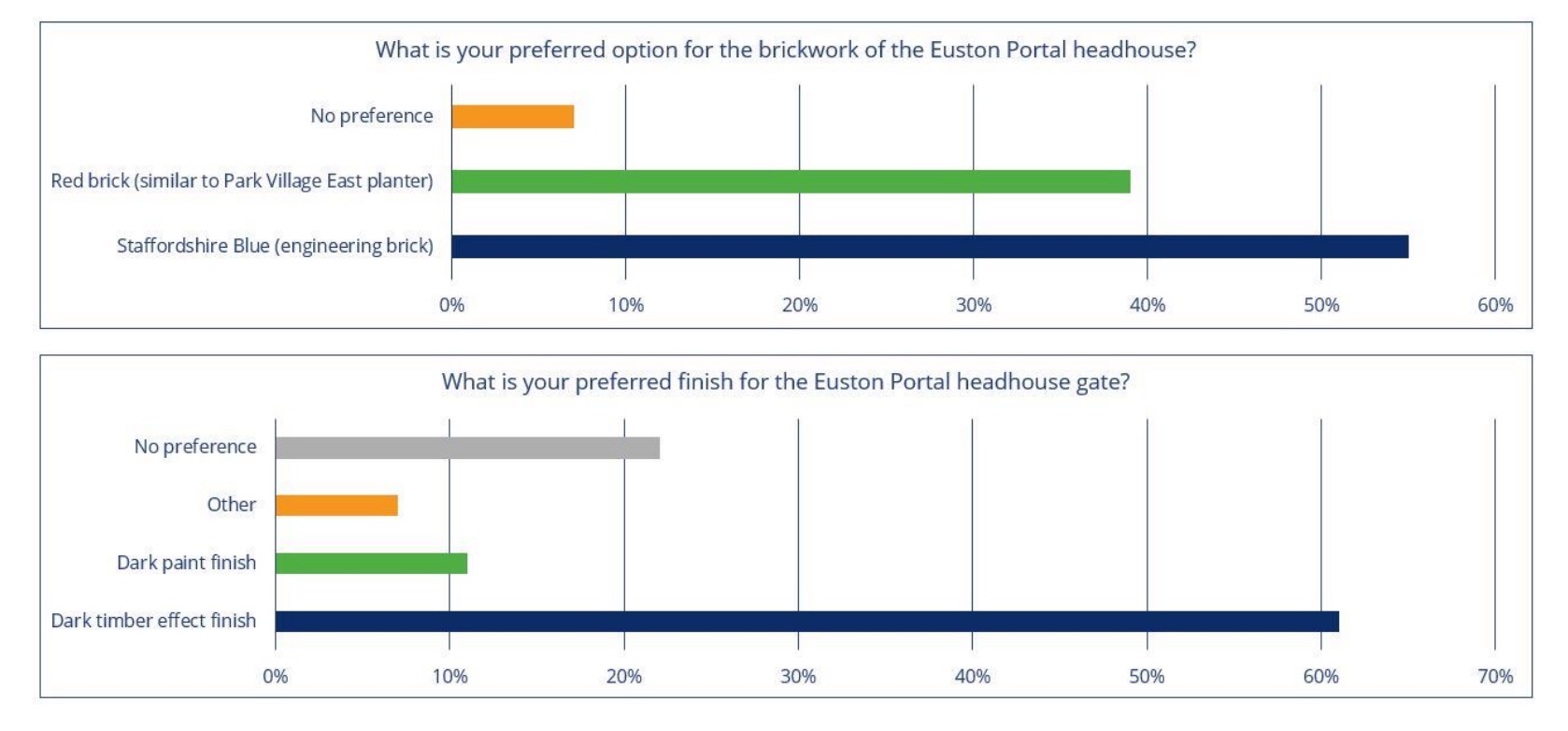
We involved the local community through a series of engagement events. As part of the ‘involve’ stage, in February 2024 we held four public events to explain the proposals and the process. We sought views on the materiality of the following in particular:
- Your preferred option for the brickwork of the Euston Portal headhouse
- Your preferred finish for the Euston Portal headhouse gate
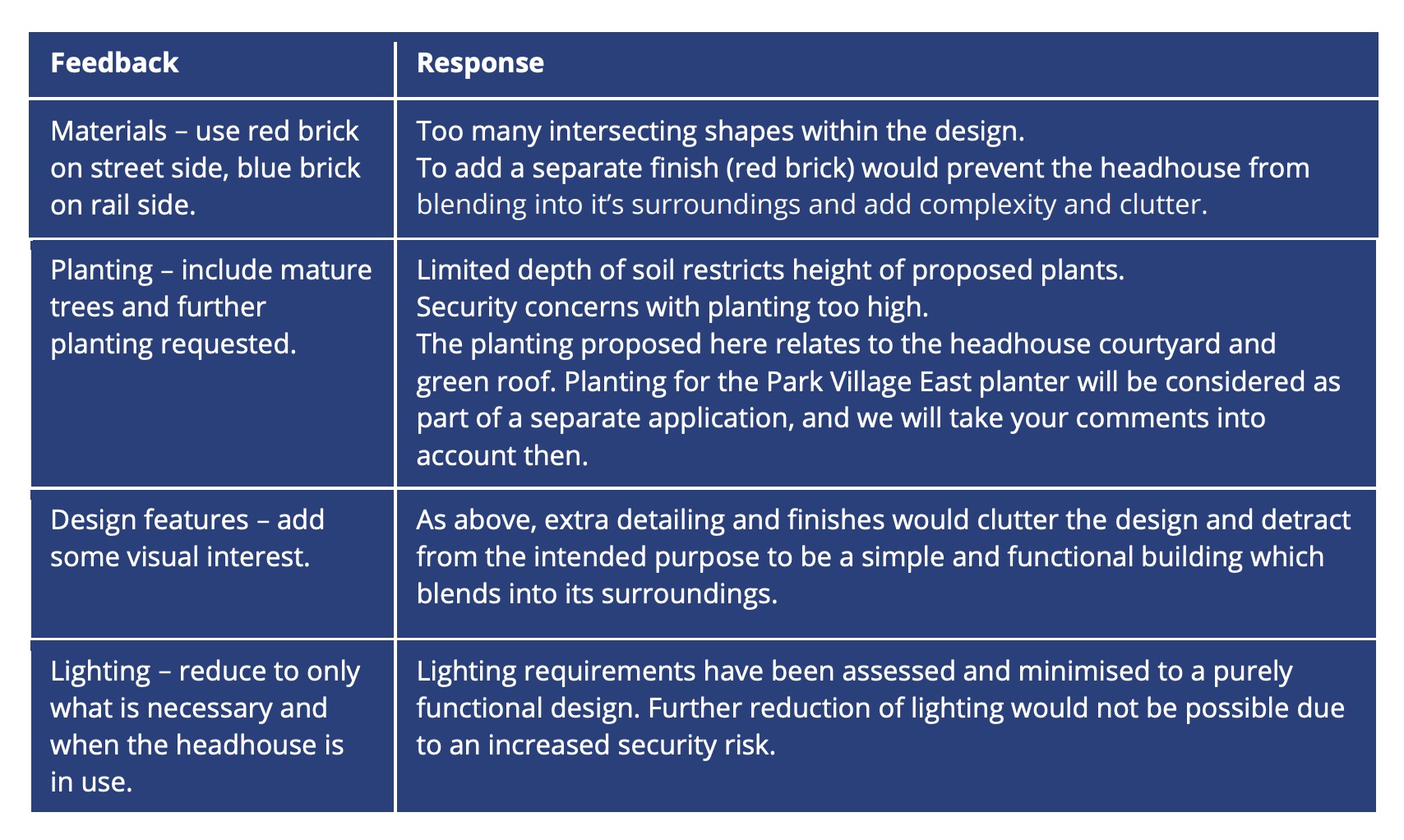
- How the proposed design of the Euston Portal headhouse could be improved
We then gathered community feedback on the headhouse design. Where possible, we have incorporated the feedback received into the final design for the Euston Portal headhouse. However, not all comments were able to be included due to competing views.
Please see below for the feedback results and comments from our ‘involve’ engagement
Document history
- Published:
- 8 July 2024
- Updated:
- 8 July 2024