Document:
Northolt tunnel: Frequently asked questions
Construction
When will you complete the Northolt tunnel?
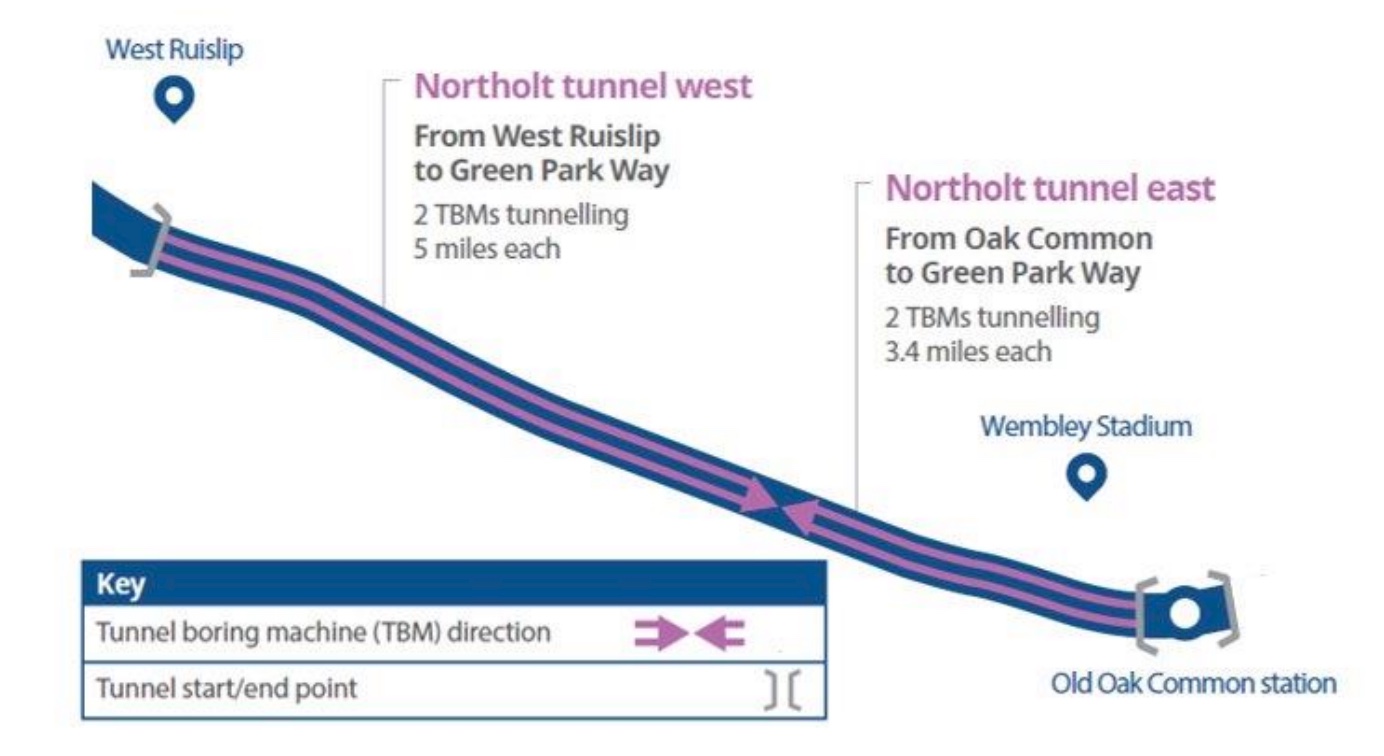
All four Tunnel Boring Machines (TBMs) have completed their tunnelling journeys, having reached Green Park Way Vent shaft in Greenford. They have been lifted out of the shaft, with TBM Anne, our final TBM, being lifted on 24 August 2025.
What’s happening next in the completed tunnels?
We are building two walkways inside each of the tunnels. There will be a wider walkway to allow passengers to safely evacuate a train and walk to the nearest cross passage and rescue train should there be an emergency. A narrower walkway, built on the other side, will be for maintenance access in the tunnel. These works will be ongoing until late summer 2026.
What else are you building on the Northolt tunnel route?
We are building ventilation (vent) shafts and headhouses along the tunnel route. Vent shafts are vertical openings that connect the tunnels to the surface and open air. They use fans located in a fan house to regulate air quality and temperature in the tunnels, allowing smoke to be extracted in the event of a fire. They will also be used as evacuation points.
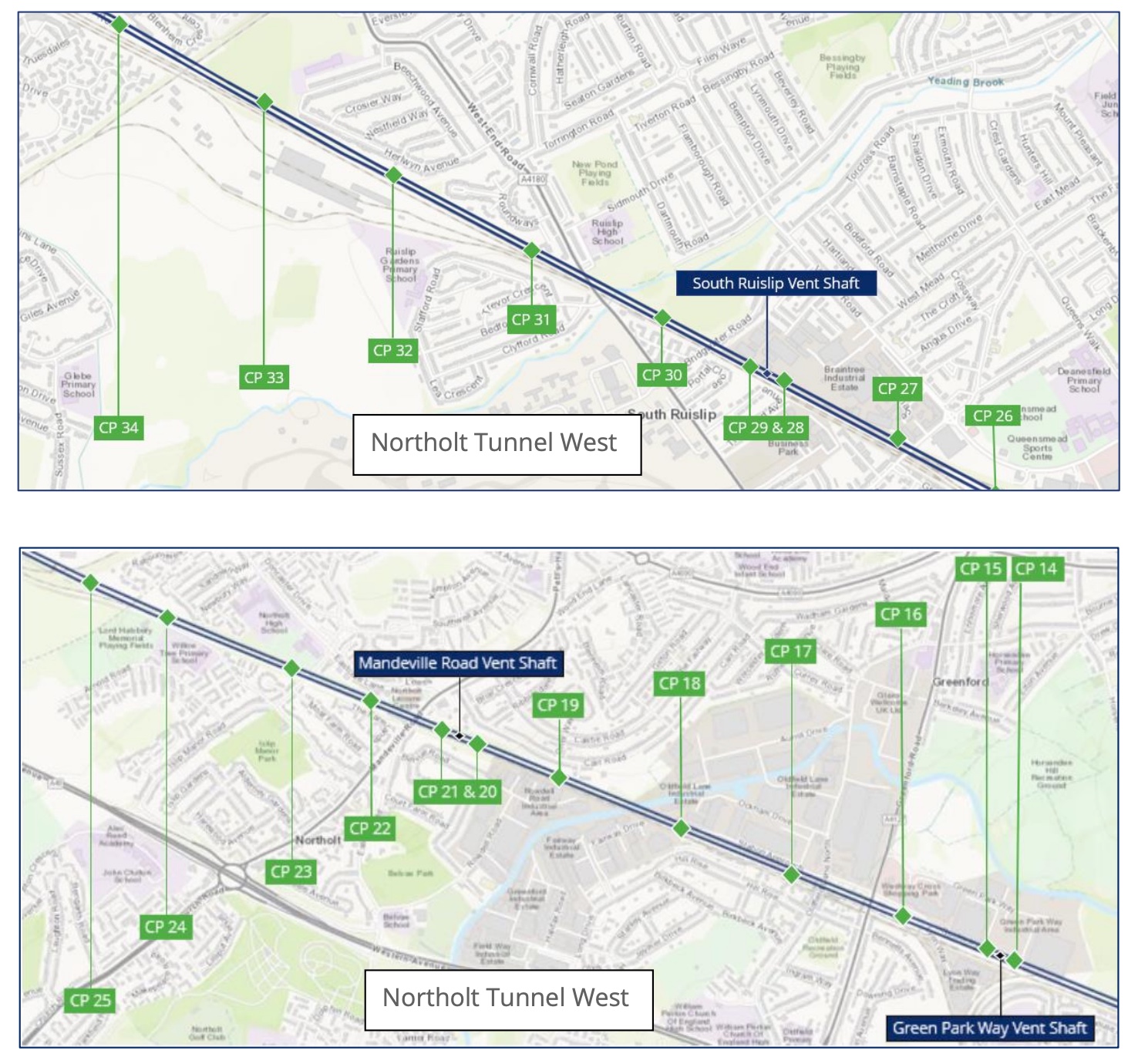
- South Ruislip Vent Shaft and Headhouse is between Ruislip Gardens and South Ruislip underground stations, close to Cineworld on Victoria Road in Hillingdon. The site is bounded to the south by the Chiltern line railway.
- Mandeville Road Vent Shaft and Headhouse is located on the old Affinity Water pumping station off Mandeville Road, Northolt. This is a residential area with Northolt Station to the west and the Network Rail corridor to the south.
- Green Park Way Vent Shaft is located along the Chiltern Line embankment, adjacent to Horsenden Hill Nature Reserve in Greenford. Green Park Way was the final destination of all four TBMs used to create the Northolt Tunnel. The TBMs were dismantled and removed from the Shaft.
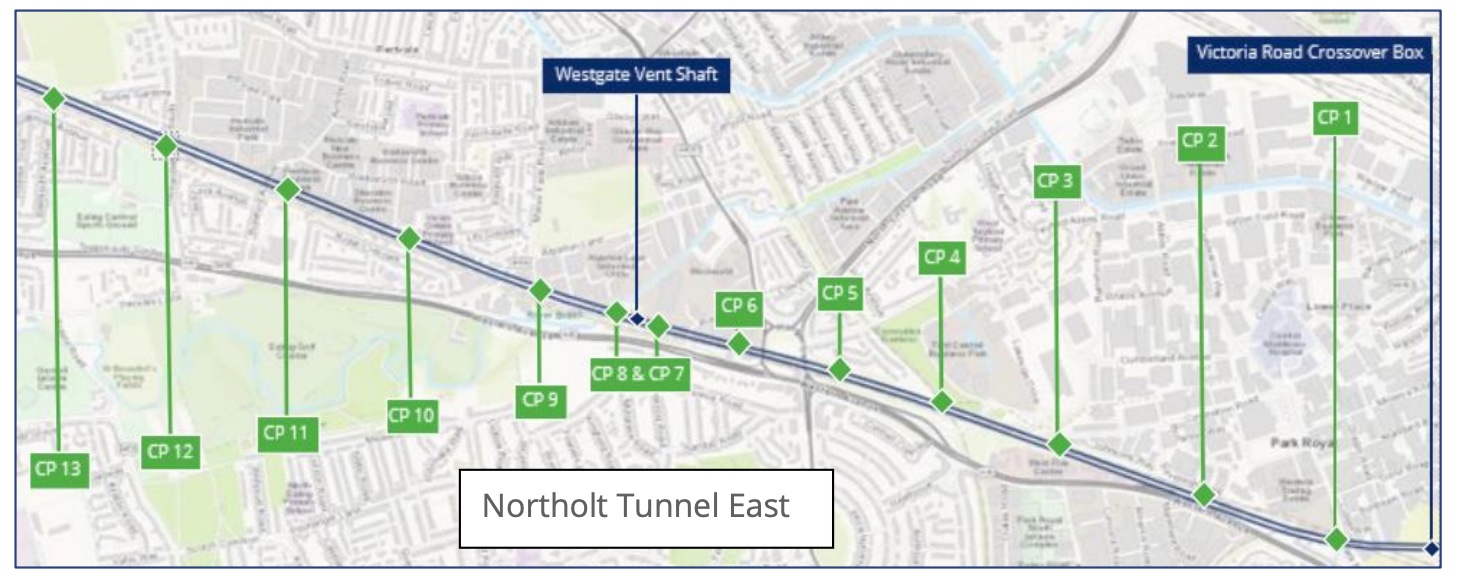
- Westgate Vent Shaft and Headhouse is located just off the A40 near Hanger Lane Underground Station.
- Victoria Road Headhouse and Ancillary Shaft is located in the Victoria Road Crossover Box site in North Acton, to the west of the new HS2 Old Oak Common station which is currently being built. The Victoria Road Crossover Box is an underground structure connecting future HS2 trains via the Old Oak Common Tunnel, allowing them to switch tracks when approaching or departing Old Oak Common Station. Old Oak Common Station is being built by Balfour Beaty VINCI Systra joint venture (BBVS).
Cross passages
What are cross passages?
These are short tunnels which connect two parallel running tunnels approximately 500 metres apart along the Northolt Tunnel route. We completed construction of the cross passages in autumn 2025. The maps overleaf show the locations of all the completed cross passages on the Northolt Tunnel. While invisible to the travelling public, cross passages will have a key role in providing a safe operational railway by providing an evacuation route for trains and passengers in an emergency.
Northolt tunnel cross passage locations
Property
Can I still make a claim if I think the tunnelling works have caused damage to my home?
If we cause any physical damage, we have a legal responsibility to repair this, under the High Speed Rail (London to West Midlands) Act 2017. We deal with claims under £10,000 through our small claims scheme and those over £10,000 through our damage claim process.
You can find out more about the HS2 Small Claims scheme in the HS2 Information Paper C10: Small Claims Scheme.
If you think that your property has been damaged as a result of our construction work please contact the HS2 Helpdesk via phone 08081 434 434, minicom 08081 456 472 or email [email protected].
In order for your concerns to be investigated, you will need to provide a description of the damage or nuisance to your property as a result of HS2 construction related activity via the HS2 Helpdesk.
Other questions
Will there be any noise from vent shafts when the trains are running?
Vent shafts regulate air quality and temperature in the tunnel, allows smoke to be extracted in the event of a fire and is used as an evacuation point.
Our vent shafts are being designed according to the commitments set out in Information paper – E22: Control of noise from operation of stationary systems. The primary aim of E22 is to deliver noise levels from ventilation which is lower than the existing background sound level at sensitive properties in the vicinity of the shaft.
The headhouses and vent shafts, in common with all our permanent structures, have been designed so that the noise from it at the closest residential property is at least five decibels lower than the existing background noise. That does not necessarily mean that noise from the headhouse won’t be heard, but the level during normal operations won’t exceed the background noise levels which existed in the area before construction works began.
What happened to the excavated material (spoil) from the tunnel?
Excavated materials from the tunnel construction has largely been used for beneficial re-use landscaping the area. Material transported out from the West Ruislip Portal in the west has been sustainably placed at the Southern Sustainable Placement Area (SSPA) located south of the Chiltern Line railway to increase biodiversity in this area, to create embankments for the railway and to build the cut-and-cover Copthall tunnel.
Material from the eastern section of the Northolt Tunnel has been transported to our Willesden Euroterminal site and redistributed to locations in Cambridge, Kent and Bedfordshire for filling quarries. Materials have also been transported to Cliffe, Kent, for reuse landscaping at a RSPB bird sanctuary.
An innovative approach has also been taken to look at one of the components of the excavated materials from our tunnels. We are taking part in a 12-month trial with Innovate UK to help reduce carbon emissions in the construction industry.
The project, called ExClay, involves using London Clay removed during tunnel construction as a low-carbon option in concrete. Through a process called calcination, the clay is heated, dried and ground into a fine powder. Once processed, the Calcined London Clay (CLC) is transformed into a useful material which can be added to concrete, replacing Portland cement.
We have now achieved the drying process, and in November carried out a successful industrial trial. Excavated London Clay was used by SCS as an industry first in the UK, to create a 10 metre walkway pour on our Northolt Tunnel East. Our participation in this trial is one of the ways we are getting closer to reaching HS2’s net zero carbon emissions goal by 2035.
For more information about HS2’s Net Zero Carbon Plan, visit: https://www.hs2.org.uk/about-us/our-documents/net-zero-carbon-plan/
Appendix
- HS2 in your area map – Here you can view our latest works notifications for your local area.
- Join our mailing list – here you can join our mailing list to receive our latest updates via email.
- Information Paper E21 – Further information about the control of ground-borne noise and vibration from the operation of temporary and permanent railways.
- Information paper – E22 – Further information about the control of noise from the operation of stationary systems.
- Code of Construction Practice (COCP) – The CoCP contains control measures and the standards to be implemented throughout Phase One of HS2.
Contact us
If you have a question about information covered in this FAQ, HS2, or our works, you can contact our HS2 Helpdesk team 24 hours a day on 08081 434 434, or email [email protected]. For those who have speech or hearing difficulties we offer a minicom service on 08081 456 472.
Document history
- Published:
- 9 December 2025
- Updated:
- 9 December 2025