Document:
Adelaide Road: Frequently asked questions
Site location and context
Where is the Adelaide Road site?
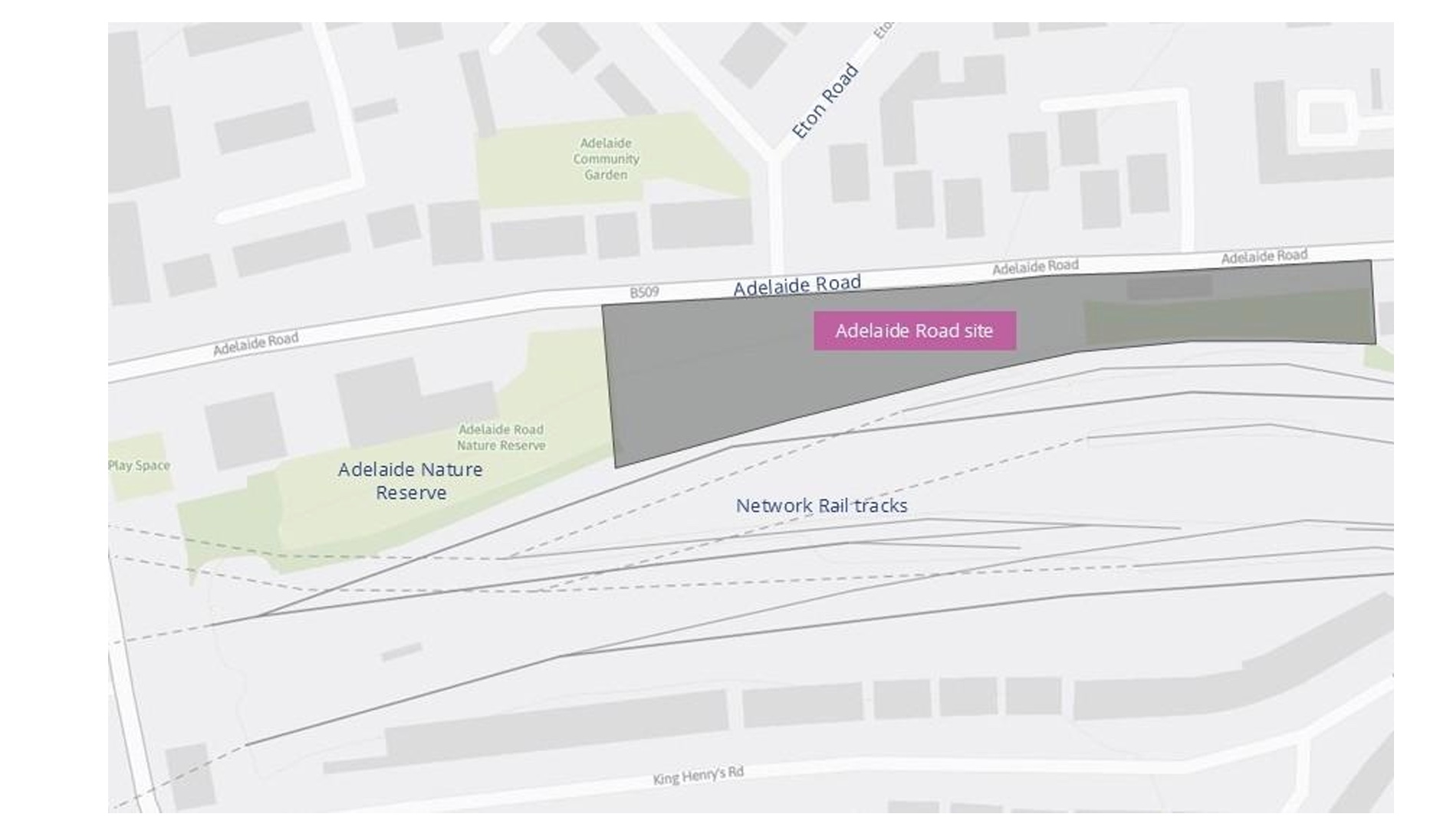
Our Adelaide Road site is on the section of Adelaide Road between Chalk Farm Road and Primrose Hill Road. The site is in the Network Rail embankment area next to Adelaide Road, opposite the junction with Eton Road and next to Adelaide Nature Reserve. It does not include the nature reserve.
What are you building at the Adelaide Road site?
We will build a ventilation (vent) shaft and headhouse at the Adelaide Road site, which will connect to the Euston Approaches to Northolt Tunnels.
Vent shafts and headhouses are an essential part of building a new railway in a tunnel.
What is a ventilation shaft?
A vent shaft is a vertical opening that connects the tunnels to the surface and open air. It uses fans located in a fan house to regulate air quality and temperature in the tunnels, provides access for emergency services and allows smoke to be extracted in the event of a fire.
What is a headhouse?
The headhouse is the building on top of the vent shaft. It contains the fire control and ventilation systems for the railway tunnels below. The headhouse will include the fan room.
What works have already taken place at the Adelaide Road site?
Works to set up our Adelaide Road site began in summer 2020. Since then, the following works have taken place:
- Clearance of vegetation within the site area
- Utility works to divert / protect utility services during construction
- Ground anchors installation
- Piling works to reinforce the ground
- Excavations to reach new site ground level and concrete pours to create the base slab for the future vent shaft and headhouse construction
Work at the Adelaide Road Ventilation Shaft and Headhouse site was brought to a ‘safe stop’ in May 2024. This was in line with the government announcement in March 2023 on the pause in work building the HS2 station at Euston.
Upcoming works at the Adelaide Road site
What works will be taking place at the Adelaide Road site?
Works at the Adelaide Road Ventilation Shaft and Headhouse site were brought to a ‘safe stop’ in May 2024. As part of an ongoing review of the construction programme by HS2, we do not now expect works to resume in 2025.
The welfare at the Adelaide Road site will be used by our staff to support the Camden Winding Engine Vaults protection works, and utility works in South Hampstead.
For more information on these works, please visit the below:
- Update: Camden Winding Vaults protection works – HS2
- Update: utility works in South Hampstead, Phase 1 – HS2
The hoarding will remain in place, and there will be 24-hour security. No construction activities relating to the ventilation shaft and headhouse will be taking place on site during this time. However, you may notice staff and vehicles on site.
What will I be able to see on your site?
You will be able to see our site office and welfare facilities within the site hoarding from Adelaide Road and King Henry’s Road, as well as from some high-rise buildings nearby.
What vegetation have you removed and how will you protect wildlife?
We have previously removed vegetation and trees within our site boundary in the Network Rail embankment area. All necessary ecological and arboricultural surveys and inspections have been completed.
We have not identified any protected species such as bats, crested newts, or badgers at the Adelaide Road site during the ecology surveys. We know that birds may nest in this area. When site clearance works take place, we will have an ecologist on site. In the event of an active nest being found within an area requiring clearance, the nest will not be disturbed until the nesting has finished.
Please note we will be carrying out vegetation trimming surrounding our Adelaide Road site during some periods. No trees will be removed, only low-level vegetation.
For more information, please visit: Update: Vegetation trimming for Adelaide Road site
Other questions
Can you reduce the brightness of the lighting in your site?
We need lighting for the security team to safely carry out their tasks (including security patrols) overnight. The flood lights have been lowered and are down-facing to reduce the level of brightness coming from our site. We have also reduced the number of lighting towers being used overnight. We understand the local community’s concerns about lighting and are continuously reviewing the lighting within our site overnight to minimise disruption.
Why are hoarding lights required?
We need lighting on the Adelaide Road site hoardings to ensure the hoarding is clearly visible to road users for their safety and to make sure we have a safe construction site. The hoarding lighting must follow regulations in accordance with British Standards and other legal health and safety requirements related to site management. Hoarding lights have been agreed with Camden Council.
Will affected residents be eligible for noise insulation in their properties?
We do not expect our works to trigger any of the noise levels defined within the E23: Control of Construction Noise and Vibration paper.
We recognise that there may be circumstances in which residents are more sensitive to construction noise or their properties may not qualify for noise insulation. In such circumstances, specific noise trigger levels and/or alternative noise control measures will be considered on a case-by-case basis to protect residents. You can view more information at Noise_insulation_scheme_booklet_CS1008a.pdf or by contacting the HS2 Helpdesk on 08081 434 434 or email [email protected].
I would like to sell my property, what support do you offer?
HS2 have a ‘need to sell scheme’ available to residents who need to sell their property but cannot because of HS2. Further information about scheme is available at Need to Sell – HS2 or by contacting the HS2 Helpdesk on 08081 434 434 or email [email protected].
Adelaide Road headhouse and compound design
What will the Adelaide Road headhouse look like?
The materials proposed in our design for the Adelaide Road headhouse are timber, metal, concrete and brickwork. We are also planning to install a green roof.
We are planning to use similar materials at all headhouses between Euston and West Ruislip. The materials palette has been chosen according to the environment, moving from brick, through metal and towards wood as we move between urban and rural locations.
We choose materials to help integrate the building into this location.
For further information on the design and to view the visualisations of the headhouse, please see the Adelaide Road Headhouse and Ventilation Shaft information boards.
What will the Adelaide Road boundary wall look like?
The permanent compound wall will be red brick. Railings are included in the design to increase visibility of the trees that will be planted within the compound.
The height of the wall will vary due to the gradient of the road, like the original wall did, but it will be no less than 2.8 metres high at any point due to security requirements.
The columns of the wall will be between 3.2 and 3.3 metres high. They will be spaced 3.8 metres apart with the brick and railings sections in between.
Between the columns, the brick face will be a minimum of 1.4 metres up to 2.6 metres high. The railings, on top of the brick face, will be a maximum of 1.4 metres high but less than this in some places. Overall, the combined brick face and railings sections will be a minimum of 2.8 metres high.
For further information on the design and to view the visualisations of the boundary wall, please see the Adelaide Road headhouse and boundary wall design factsheet.
What will the future lighting plans be like?
We will be illuminating various zones throughout the site with a mixture of lighting fixtures. When the site is unoccupied, a dimming factor will be applied to all lights to minimise lighting pollution. However, the lighting levels will increase in the following scenarios:
- emergencies, when switched on locally/remotely
- when vehicles are manoeuvring
- upon gate opening
- when intrusion is detected by the CCTV security system
For further information on the future lighting plans, please see the Adelaide Road Headhouse and Ventilation Shaft information boards.
What are the future landscape plans?
Our future landscape plan for the Adelaide Road site considers local ecological and vegetation requirements for next to a live railway. Our current future landscape design includes block/slab paving and trees and scrub habitat planting. We’re also planning to install a green roof on the headhouse buildings.
Our key landscape priorities are to:
- embed the building into the landscape,
- provide visual screening and improve biodiversity of the site,
- integrate the entrance by Adelaide Road with local context and heritage.
For further information on the future landscape plans, please see the Adelaide Road Headhouse and Ventilation Shaft information boards.
What engagement has taken place on the design of the Adelaide Road headhouse and compound?
In September 2021, we showed you our scheme design for the Adelaide Road headhouse and compound. Residents and the community were encouraged to provide further feedback on the appearance and landscape of the headhouse and compound before we submitted our final design to Camden Council.
During the engagement period in September, you gave us feedback on the following questions about our future design of the Adelaide Road headhouse and compound. These questions and the summary of this feedback is outlined below:
- Do you think the materials used for the future headhouse will help integrate the building with the local context?
Yes – 7.97%
No – 92.03%
You said: “The materials should be hidden behind a green wall and do not keep in line with the local area”
We did: We have considered incorporating green walling to maximise natural screening as far as practicable. Green walling is incorporated into brick walling found on the southern elevation where it would not conflict with CCTV and lighting requirements.
- Do you think tree and shrub planting to partially screen the headhouse building from Adelaide Road is a good idea?
Yes – 96%
No – 4%
You said: “We would like screening on all sides and replanting of the trees and vegetation which have been removed”.
We did: Tree and shrub planting has been developed further to enhance screening of the headhouse building from Adelaide Road. This includes the use of new planting species to create more natural looking screening. We plan to enhance the amount of green walling and natural screening as far as practicable. Our current design shows a green wall on the south elevation, to reduce impact on CCTV and lighting coverage of the compound.
- The proposal is to incorporate railings into the boundary wall to increase visibility of the greenery behind. Do you agree with this approach?
Yes – 32.64%
No – 67.36%
We appreciate the community views about the appearance of the brick wall. Inclusion of railings will help to expose more of the green planting/screening and soften the visual impact along Adelaide Road.
- We are proposing a red or grey brick wall. Which colour of brick do you think is most appropriate for the boundary wall?
Grey – 9.15%
Red – 90.85%
You said: “Rebuild the brick wall to its original colour and reuse the bricks from the previous Victorian wall”.
We did: Feedback from the community and London Borough of Camden has been clear in stating a preference for red brick. We have listened to this feedback and the design has been modified accordingly to include for a red brick wall along the Adelaide Road frontage.
Planned engagement activity in 2025
Notifications about works about events in your area
As part of our commitment to keeping you informed, we will continue to send notifications about our works and events in your area throughout 2025. You can find our latest updates here: In your area map – High Speed 2 (hs2.org.uk).
Monthly virtual drop-ins
You can book a 20-minute slot between 4pm to 6pm to speak with the community engagement team from HS2 and SCSJV on the third Wednesday of every month.
To register your attendance for one of our virtual drop-ins, please visit HS2.org.uk/events.
Document history
- Published:
- 5 September 2025
- Updated:
- 11 September 2025