HS2 in Hillingdon
HS2 in your area
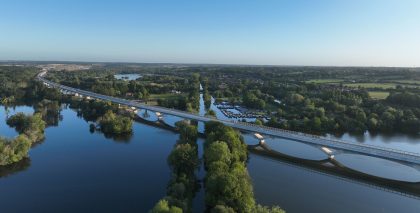
The railway enters Hillingdon in a tunnel from Ealing. It comes to the surface at West Ruislip, then crosses the Colne Valley lakes on a viaduct.
What we're building
Northolt tunnel
The Northolt tunnel runs for 8.4 miles (13.5km) beneath west London, carrying passengers from Old Oak Common to West Ruislip.
Five headhouses will support the tunnel’s ventilation and safety systems, and there will also be another headhouse to support the West Ruislip Portal.
Each headhouse sits above either a ventilation shaft or tunnel portal, providing ventilation and emergency access.
Two of these structures are located in the London Borough of Hillingdon:
South Ruislip headhouse and ventilation shaft
The South Ruislip headhouse sits between Ruislip Gardens and South Ruislip Underground stations, close to Cineworld on Victoria Road. It is built above a ventilation shaft that serves the Northolt tunnel and provides emergency access. The Chiltern line railway runs along the southern boundary of the site.
It forms part of the HS2 green corridor, connecting new wildlife habitats, woodlands and community spaces along the route.
West Ruislip Portal headhouse
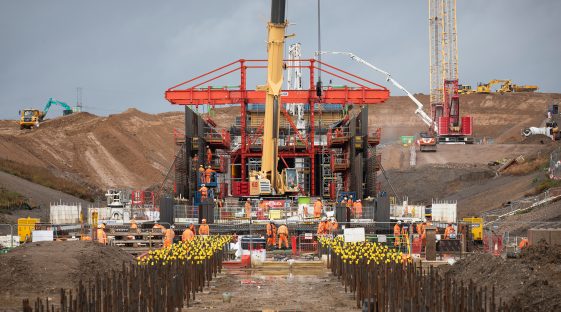
At the western end of the Northolt tunnel, we’re building a headhouse above the West Ruislip portal, where the railway enters and exits the tunnel. We’re also constructing the portal’s porous roof, with completion expected in 2028.
The headhouse will sit around nine metres above track level and has been designed to reflect the character of the local area. Built mainly from timber and metal, it will feature a green roof to enhance biodiversity. The surrounding area will also be landscaped to help the structure blend into its environment.
Read about the HS2 works and developments taking place in Hillingdon
Noise barriers
Noise barriers are being constructed along the route in Hillingdon, between the Copthall tunnel and the porous roof near the West Ruislip portal. They are concrete panels with an acoustic absorber panel on the inside to contain, deflect and absorb the amount of sound produced by passing trains and reduce the noise as experienced by residents. The barriers are five metres high on the south side of the route, where there are more residential properties, and two and a half metres high on the north side.
They are currently being installed and should be completed by 2027.
Read about the HS2 works and developments taking place in Hillingdon
Copthall tunnel
Copthall green tunnel is 880 metres long. It runs between Harvil Road to the west and Breakspear Road South to the east.
We built it using a cut-and-cover technique. This involved digging a trench, constructing the tunnel structure, then covering it with soil. For this final step, we used earth excavated from the two tunnels at West Ruislip portal.
The tunnel has two portal ends and five natural ventilation openings. Each opening is 15 to 17 metres (49 to 56ft) high.
Now the tunnel structure is complete, we’ll plant the top and surrounding area. This will help it blend with the natural landscape and create new habitats for local wildlife.
Read about the HS2 works and developments taking place in Hillingdon
Habitat creation sites near Copthall tunnel
We’re creating more than 40 hectares of new wildlife habitat around the Copthall tunnel, between the HS2 tunnel portal near West Ruislip underground station and the western end of Harvil Road. These areas are dedicated to nature, and they’ll support wildlife along the route for decades to come.
We call them Sustainable Placement Areas. They’re part of our commitment to leaving a positive environmental legacy in the area. We’ve built two Sustainable Placement Areas within our site, both from material excavated from the Copthall tunnel. The Northern Sustainable Placement Area (NSPA) sits north of Newyears Green Lane and west of Breakspear Road South. The Southern Sustainable Placement Area (SSPA) sits between Harvil Road and Breakspear Road South, south of the Chiltern line.
We’re now landscaping both areas. This involves seeding and whip (very young tree) planting. Seeding establishes diverse grasses beneath the planting, while whip planting introduces a range of species we’ve specifically selected to suit the area. We’ll install more than 70,000 individual plants, trees and hibernacula to create a series of diverse wildlife habitats that will improve biodiversity for local flora and fauna.
Read about the HS2 works and developments taking place in Hillingdon
Harvil Road
As part of our work at Copthall tunnel, we’ve realigned Harvil Road. The new road opened in February 2024. We built a new section of road between Skip Lane and The Dogs Trust, with a new entrance to Skip Lane from Harvil Road. We also built a new bridge to carry the new road over the existing Chiltern line. This has improved safety outcomes for residents. We removed the old bridge in September 2026, as we no longer needed it.
This work was essential, because the new road sits on a raised embankment that forms part of the cut-and-cover area of the Copthall tunnel, where the HS2 railway will travel under the road.
Read about the HS2 works and developments taking place in Hillingdon
Colne Valley viaduct
The Colne Valley viaduct is the longest railway bridge in the UK and one of the most significant structures on the HS2 route. Stretching 2.1 miles (3.4 km), it carries the railway across the Colne Valley Regional Park, connecting London and the Midlands while carefully navigating one of the country’s most environmentally sensitive landscapes.
Read about the HS2 works and developments taking place in Hillingdon
How we manage construction
We work to minimise disruption for residents and businesses, reduce the impact on roads and transport, protect the environment, and keep communities informed at every stage.
Current work in the area
How and why we're building HS2


HS2 works near you
Sign up for updates about construction in your area. We’ll tell you what we’re building, when we’re working and what we’re doing to reduce disruption.