Document:
Euston Tunnel: Frequently asked questions
Tunnel location
Where is the tunnel?
The Euston Tunnel consists of two bored tunnels – an upline and a downline – that will run for about 4.5 miles (7.2 km) between the Euston and Old Oak Common Station. You can find out more about the final destination of the tunnel in Euston here.
There are two ventilation (vent) shafts and headhouses being built on this section of the route: Adelaide Road Vent Shaft located in the Network Rail embankment area between Chalk Farm and Primrose Hill Road, and Canterbury Road Vent Shaft, located in South Kilburn behind Canterbury Road and Canterbury Terrace.
On this route, we also have the Atlas Road Logistics Tunnel, which is 853 metres long between the Atlas Road site and Old Oak Common Station site. To support future tunnelling works, the logistics tunnel will be used to deliver materials and remove spoil to and from the Euston Tunnel. You can view more information about the Atlas Road Logistics Tunnel here.
Structure and shape
How deep will the tunnels be?
The depth of the Euston Tunnel between Old Oak Common Station and Euston will vary between 12 metres and 60 metres. Each tunnel will have an inner diameter of 7.55 metres.
If you would like specific tunnelling depth information, please get in touch by contacting the HS2 Helpdesk on 08081 434 434 or email [email protected]
What are cross passages?
Cross passages are short tunnels which connect two parallel running tunnels and provide a safe evacuation of trains in an emergency. Cross passages will be located about every 500 metres along the tunnel route and will be between 24 to 50 metres below ground. There are eighteen cross passages along the Euston Tunnel route. The cross passages will be constructed once the TBMs have passed.
Construction
How will the tunnels be dug?
We will launch two Tunnel Boring Machines (TBMs), which are specialist pieces of equipment used for tunnelling, to build the Euston Tunnel. The TBMs will launch from the Old Oak Common Station site and will complete their journey at the Euston Cavern Shaft in Camden.
Twin tunnels will be bored: one for trains travelling from the West Midlands to London, known as the London Tunnel (or “upline”), and one for trains travelling from London to the West Midlands known as the Birmingham Tunnel (or “downline”).
Excavated material from the HS2 London tunnels will be removed by conveyor to the Willesden Euroterminal site in the Old Oak and Park Royal area, and will be transported to locations in Cambridge, Kent and Bedfordshire.
When will you start constructing the tunnel?
We expect the Euston Tunnel TBMs to be launched in early 2026, and to take about 18 months to complete their journey.
How are cross passages constructed?
Cross passage construction involves breaking into the side of the completed tunnel. The ground is dug out in short lengths, and a sprayed concrete lining is used to form the interconnecting tunnel. After each section is mined and lined, a temporary concrete face forms the end of the cross passage. This method is a proven, safe way to create cross passages between the tunnels. The temporary face will then be removed, and the above cycle is repeated until the cross passage is completed. This process will take around one week per cross passage.
What are the working hours?
Once the TBMs are launched, they will operate 24 hours a day, 7 days a week until the construction of the tunnel is complete. A crew of operatives will control each TBM, working in shifts to keep the machines running 24/7. They will be supported by people on the surface, managing the logistics and maintaining the smooth progress of the tunnelling operation.
The TBMs will sometimes stop for maintenance and to provide respite for the tunnelling operatives at various points during the year.
Materials
How are the tunnel segments being delivered to the TBMs?
The TBMs need to be fed a constant supply of segments which will form the tunnel. Six precast concrete segments comprise a tunnel ring. Segments for the Euston Tunnel are being prepared, cast and cured at an off-site facility in Hartlepool. We will receive the concrete segments to the Old Oak and Park Royal area by rail to the Willesden Euroterminal site. The concrete segments will then be transported to the Atlas Road site via a logistics bridge over the Grand Union Canal. From the Atlas Road site, we will transport segments via the Logistics Tunnel to the Euston Tunnel.
Managing impacts
Will people living near the tunnel be able to hear the tunnels or cross passages being built?
We are taking all reasonable steps to control ground-borne noise and vibration so that it does not exceed the Lowest Observed Adverse Effect Levels (LOAEL) set out in Information Paper E21.
Based on experience from London Underground, ground-borne noise or vibration below the LOAEL may still be perceptible to some people some of the time depending on the person’s sensitivity to noise and how much sound there already is in the environment. But noise exposure below LOAEL is unlikely to have adverse effects on health or quality of life.
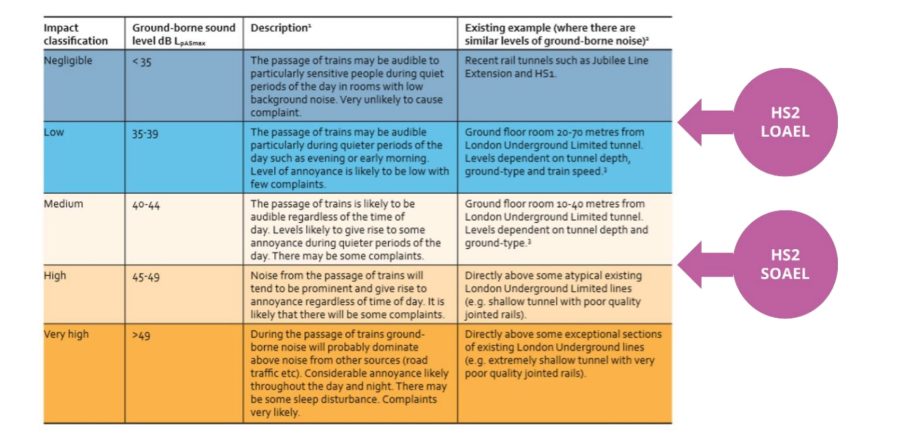
Our predictive assessments of ground-borne noise and vibration indicate that there is a low risk of vibration or ground-borne noise levels across the tunnelling route, with the residential buildings in these areas below the LOAEL level. This is because of the depth of the tunnels in dense London Clay, which reduces the risk of ground-borne noise and vibration from our tunnelling works.
Our community engagement team will be carrying out targeted engagement to make people aware of when the tunnel boring machines are likely to pass nearby, the duration of which should be no more than two to three days. We will also inform up to four weeks in advance those residential properties near where the cross passages will be constructed.
How will you manage the impacts of tunnelling?
We recognise that residents may be concerned about tunnelling and related activities, and we will aim to reduce the impacts as much as possible. The measures we will use to do that include:
- Selecting a construction methodology that reduces settlement and noise and is significantly quicker than other tunnelling techniques,
- Using best-in-class machinery that has been bespoke manufactured for the purposes of digging the Euston Tunnel.
- Noise and vibration monitoring will be completed along the alignment to ensure we keep within agreed limits, outlined in the Code of Construction Practice (CoCP) and Information Paper E23: Control of construction noise and vibration.
- HS2 completed an Environmental Impact Assessment in 2013 which set out the impacts and effects of tunnelling.
- Assess and adopt construction methods which reduce the impact to the community (such as the use of the logistics tunnel to remove excavated spoil and deliver tunnel segments to the TBM).
What are you doing to limit the impacts on residents and buildings?
In building the new railway, we are committed to respecting the people and communities we affect and being sensitive to their needs. We are already implementing measures to reduce the impacts of our upcoming major excavations.
First, we aim to cause as little ground movement as possible by controlling the way the excavation work is carried out and if necessary, treating the ground or the structures themselves to reduce movement.
Measures to address ground movement and potential damage include:
- Employing industry best practice when undertaking the major excavations. The application of in-tunnel mitigation measures has been shown to reduce ground movements generated by construction works. For example, installing our concrete tunnel linings to support the ground as quickly as possible, limits the amount of time the ground is exposed and can move.
- Carefully planning the works and choosing the best equipment to avoid or reduce noise, vibration, dust, and ground movement within the worksite – and therefore the surrounding area – as much as we can.
- Surveying and investigating before we start major excavations to understand the condition of the ground, buildings, bridges, utilities and other structures, and to assess if we need to provide any extra protection ahead of starting the major works.
- Ground treatment, such as injecting grout or installing ground anchors to add strength and reduce or offset movement.
- Designing specific solutions for buildings or structures that we have identified as being at risk. These solutions can provide additional strength to help the structures accommodate the ground movements or lessen the effect of the ground movements.
- Monitoring to be sure our forecasts and baseline measurements are in line with the actual situation once major works start. If there are unexpected monitoring results, we assess the situation and decide on next steps. These may involve more frequent monitoring, changing our working methods, or adding extra support or insulation to structures.
Ground movement
What is ground movement?
Ground movement – or settlement – is the technical term given to the way the ground moves around a hole after it has been dug out. It also occurs naturally when trees drink a lot of water for example. Building tunnels, shafts, and basements causes a small amount of extra movement to the ground nearby.
We know how to limit the effects of this movement on buildings. In most cases, ground movement does not cause damage to properties. In some cases, there may be small cracks in plaster, and in a few cases doors or windows may stick. In very rare instances, settlement can affect the structure of the building. For more information about ground movement, please read the HS2 Phase One HS2 Guide to Ground Settlement.
How do you monitor ground movement?
We use satellite monitoring, laser and physical monitoring via prisms, stick-on targets and sensors installed on local properties, structures and in the railway cutting. We use these methods to monitor ground movement across the local area which helps us understand existing levels of movement, and to accurately predict changes due to our works. Ground movement typically happens slowly, allowing time to respond appropriately and safely to any changes.
We also install small metal studs in publicly accessible spaces, such as on footpaths and roadways, which enable us to monitor levels very accurately and determine trends over long periods.
Will your works cause ground movement?
We have been monitoring the area for a few years now to understand these usual patterns of movement in the area.
Our major excavations, such as tunnelling, will create additional ground movement – beyond that caused by seasonal change or large trees drawing water from the ground for example. This additional movement has the potential to cause changes or damage to structures such as utilities, buildings, bridges and rail lines. The likelihood and degree of damage to a structure depends on many factors, including how it is constructed, the condition of the structure and its location in relation to major works. It is also dependent on the type and scale of excavation work itself.
We continue to monitor ground movement and nearby structures to verify predicted movement levels and potential impacts from HS2 works.
There will be occasions where we will strengthen or mitigate structures prior to nearby major excavations to protect against potential damage.
How are residents protected from the effects of settlement?
HS2 is responsible for any damage caused to your house as a result of the construction or operation of the railway.
HS2 has a well-established settlement policy that involves the principles of assessing, monitoring, recording, protecting, and repairing. Further information can be found at HS2 Guide to ground settlement.
What is a settlement deed?
This is a legal agreement between HS2 Ltd and owners of properties within 30 metres of an excavation. HS2 will be responsible for paying for any property repairs related to its works, whether the property owner holds a deed or not. However, some people find them useful if selling or borrowing, for example.
You can find out more about settlement and settlement deeds, including a set of FAQs, here.
If your property is eligible for a settlement deed, you will be contacted by post. If you have any questions on settlement deeds, please get in touch with our dedicated Property team by email at [email protected] or contact the HS2 Helpdesk on 08081 434 434.
Kensal Green Cemetery
Does the tunnel route go under the Kensal Green Cemetery?
Yes. The Euston tunnel will be approximately 16 metres (52 feet) below ground level under the cemetery. We have carried out ground movement assessments which concluded that there will be minimal ground movement and negligible impacts on the cemetery’s monuments.
We have carried out pre-condition surveys which involves individually assessing every monument in the cemetery to record their current condition. Some monuments will require extra monitoring or protective works which will be put in place before we begin our tunnelling works in early 2026. Our monitoring will continue during tunnelling and once the Tunnel Boring Machines (TBMs) have completed their tunnelling under the cemetery, we will carry out post-condition surveys of the cemetery site. We continue to work closely with the Royal Borough of Kensington and Chelsea, the General Cemetery Company and the Friends of Kensal Green Cemetery to keep them regularly updated on our works
How will you manage the Kensal Green Cemetery site during tunnelling?
Kensal Green Cemetery will remain open to the public during our works. We recognise that the cemetery is one of London’s most important heritage sites and our routine monitoring activities will be discreet, minimising visual and physical impact, so the cemetery can remain a calm place to visit.
We will continue to work closely with the Royal Borough of Kensington and Chelsea, the General Cemetery Company and the Friends of Kensal Green Cemetery to ensure our works will have minimal disruption on regular activities.
When possible, we will plan above ground activities to avoid funerals or commemorative ceremonies. If you have specific concerns or queries, please contact our HS2 Helpdesk on 08081 434 434, or email [email protected]. For those who have speech or hearing difficulties we offer a minicom service on 08081 456 472.
Surveys and notices
What is a pre-condition survey?
Pre-condition surveys are visual inspections by an independent accredited surveyor to capture the existing condition of a property. They are required for all properties along the HS2 route within the zone for predicted ground movement of more than 1 millimetre for listed buildings and more than 10 millimetres for non-listed buildings.
If your property is eligible for a pre-condition survey, you will be contacted by post. If you have any questions on about pre-condition surveys, please get in touch with our dedicated Property team by email at [email protected] or contact the HS2 Helpdesk on 08081 434 434.
What is subsoil notice?
he term subsoil is used to refer to the part of the land which is below its natural surface. English property law recognises that, unless specified otherwise, freehold ownership of land includes the ground below the surface of the land to an unlimited depth. In some cases, leaseholders may share these rights, which may include the subsoil beneath adjacent public roads or streets. The HS2 tunnels will be constructed in a stratum of subsoil generally more than nine metres below ground level. This stratum of subsoil will be compulsorily acquired using powers within the HS2 Act 2017 and, if you have an interest in the subsoil, you will be entitled to receive fixed value compensation. Subsoil notices will be sent to owners of properties directly above the tunnels to confirm that your subsoil rights will be obtained by HS2.
For further information please refer to Using subsoil for HS2.
Vent shafts
What is a vent shaft?
A vent shaft is a vertical opening that connects the tunnel to the surface and open air. It uses fans located in a fan house to regulate air quality and temperature in the tunnel, allowing smoke to be extracted in the event of a fire and is used as an evacuation point.
Will there be any noise from vent shafts when the trains are running?
Vent shafts regulate air quality and temperature in the tunnel, allows smoke to be extracted in the event of a fire and is used as an evacuation point.
Our vent shafts are being designed according to the commitments set out in Information paper – E22: Control of noise from operation of stationary systems. The primary aim of E22 is to deliver noise levels from ventilation which is lower than the existing background sound level at sensitive properties in the vicinity of the shaft.
The headhouses and vent shafts in common with all our permanent structures – has been designed so that the noise from it at the closest residential property is at least five decibels lower than the existing background noise. That does not necessarily mean that noise from the headhouse won’t be heard, but the level during normal operations won’t exceed the background noise levels which existed in the area before construction works began.
Property
I would like to sell my property, what support do you offer?
HS2 have a ‘need to sell scheme’ available to residents who need to sell their property but cannot because of HS2. Further information about scheme is available at Need to Sell – HS2 or by contacting the HS2 Helpdesk on 08081 434 434 or email [email protected]
Is my property at risk?
If your property requires additional measures to protect against damage from additional ground movement, our team will have already been in contact with you. If you have not heard from us and are worried about damage from tunnelling, please contact HS2 Helpdesk and we can tell you what to expect from tunnelling.
Should your property be identified in future studies as one that may benefit from extra monitoring or protective measures, we will contact you.
Most properties will not experience additional ground movement or damage as a result of HS2 works. We do understand many properties in the area already experience cracks and sticking doors and windows from seasonal and other types of ground movement. Our technical review panel monitors all HS2 works and associated ground movement. This data is used to assess building damage claims submitted to HS2 Helpdesk.
You can find out more about the process for assessing potential damage from ground movement, and how to claim for any damage, in the HS2 Works Information Paper C3: Ground Settlement.
Appendix
- HS2 in your area map – Here you can view our latest works notifications for your local area
- Join our mailing list – here you can join our mailing list to receive our latest updates via email
- Need to sell scheme – Here you will find information about a scheme available to owner-occupiers who can show that they have a ‘compelling reason’ to sell their property but have been unable to do so (other than at a greatly reduced price) as a direct result of the announcement of the route of HS2.
- Using subsoil for HS2 – Here you will find information which will explain:
- How and why, we obtain and use subsoil that is beneath land and properties;
- The legal permission we need and your rights to compensation;
- How we will build the tunnels; and
- How we will keep you informed.
- HS2 Guide to ground settlement – This guide tells you about settlement on HS2 and provides information on:
- how your property might be affected;
- what we will do to protect your property or pay for repairs;
- how we will keep you informed; and
- how to apply for a settlement deed.
- Environmental Statement (ES) – Further information about the environmental minimum requirements for HS2 Phase One.
- Information Paper E21 – Further information about the control of ground-borne noise and vibration from the operation of temporary and permanent railways.
- Information paper – E22 – Further information about the control of noise from the operation of stationary systems.
- Information Paper E23 – Further information about the control of construction noise and vibration
- Code of Construction Practice (COCP) – The CoCP contains control measures and the standards to be implemented throughout Phase One of HS2.
Document history
- Published:
- 9 December 2025
- Updated:
- 9 December 2025